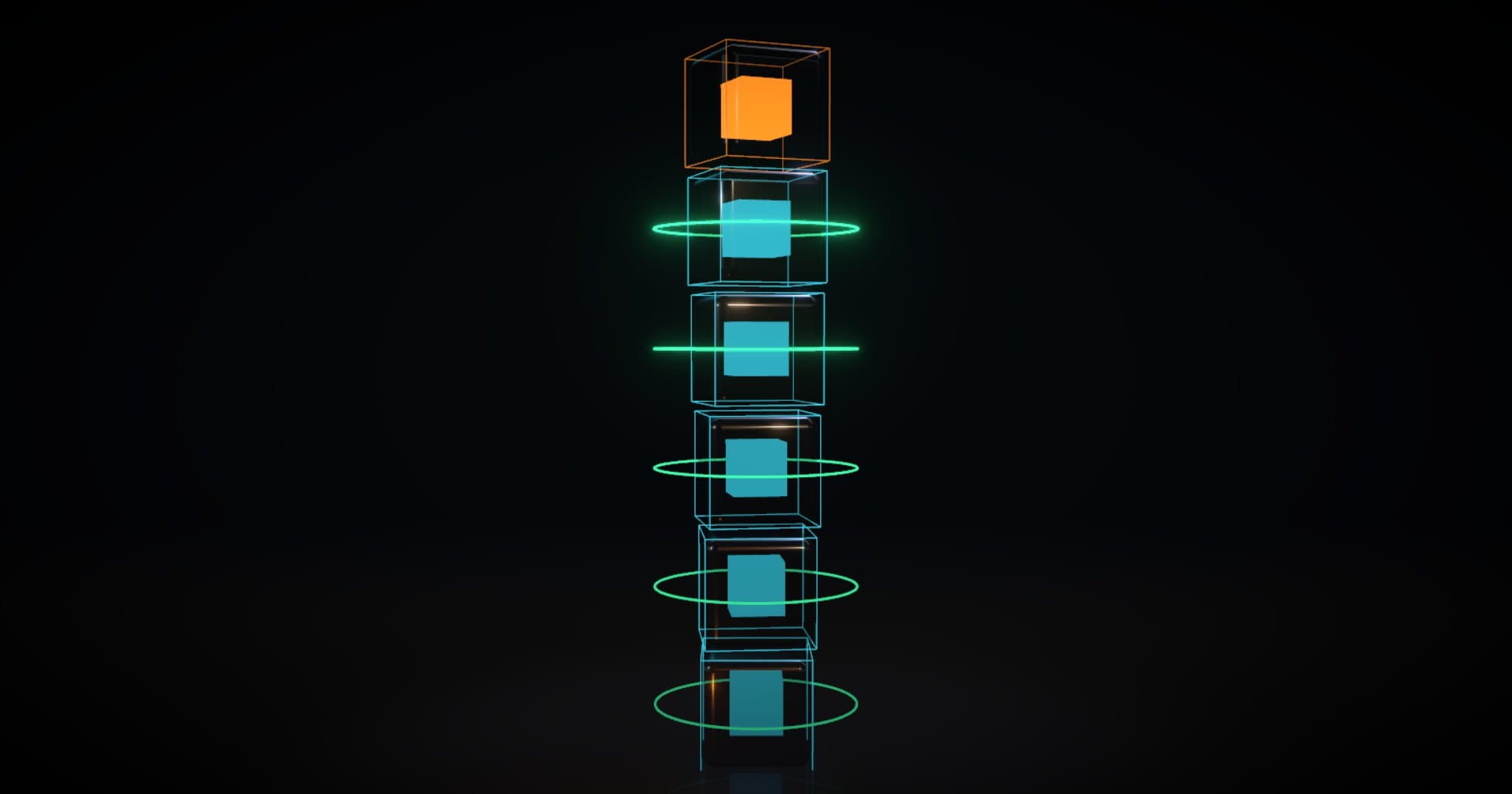
A miner finds a valid block, broadcasts it, and collects the reward. Story over? Not quite. What happens in the minutes and hours after a block is found explains why exchanges ask you to wait for "6 confirmations", what an orphan block really is, and why newly mined bitcoin cannot be spent right away.
Key takeaways
- A transaction has one confirmation when it is included in a block, and gains one more with every block added on top.
- Each confirmation makes a transaction exponentially harder to reverse. Six confirmations, about an hour, is a common standard for large amounts.
- When two miners find a block at almost the same time, one of them ends up as a stale block (often called an orphan) and its reward disappears.
- Newly created coins cannot be spent until 100 more blocks have been added on top, about 17 hours.
What a confirmation is
When your transaction is included in a block, it has 1 confirmation. When another block is added after that one, it has 2, and so on. The number of confirmations is simply how deep your transaction is buried in the chain.
Depth matters because of proof of work. As we explain in What Is Bitcoin Mining?, rewriting a block means redoing its work and the work of every block after it, faster than the rest of the network. Each new block on top adds another layer of work an attacker would have to redo.
Why "6 confirmations"?
Early in Bitcoin's history, the whitepaper's math showed that an attacker controlling a minority of the hashrate has a chance of catching up that shrinks very quickly with every block. Six blocks became the rule of thumb for "practically final". At about 10 minutes per block, that is roughly an hour.
In practice, services choose their own thresholds:
| Situation | Typical confirmations |
|---|---|
| Small everyday payment | 1 to 2 |
| Exchange deposit | Often 1 to 6, depending on the platform |
| Very large transfer | 6 or more |
- Confirmation: included in a block
- 1
- Confirmation: included in a block
- For the classic 6 confirmations
- ~1 hour
- For the classic 6 confirmations
- Blocks before newly mined coins can move
- 100
- Blocks before newly mined coins can move
Stale blocks, also called orphans
Blocks take a few seconds to travel across the world. Once in a while, two miners find a valid block at nearly the same height and time. For a moment, the network is split: some nodes saw block A first, others saw block B.
The tie breaks with the next block. Whichever branch gets extended first becomes the one with the most accumulated work, and every node switches to it. The other block becomes stale: its transactions return to the mempool, to be included again later, and its miner loses the reward.
Stale blocks have become rare as miners and pools have invested in faster block propagation, but they are the reason a single confirmation is not treated as final for large amounts.
Orphan or stale?
People commonly say "orphan block", but the more precise term is stale block: a valid block that ended up outside the main chain. Technically, an orphan is a block whose parent a node has not seen yet.
The 100-block rule for new coins
The transaction that pays the miner, called the coinbase transaction, comes with a special rule: its coins cannot be spent until 100 more blocks have been mined on top. That is about 17 hours.
The reason is the stale block risk. If a block ends up outside the main chain, its reward vanishes. Without the waiting period, a miner could spend coins that later cease to exist, and anyone who received them would be left with nothing. The 100-block maturity rule makes that practically impossible.
It is one of the reasons mining pools, and services built on top of them, credit rewards on a schedule rather than the instant a block is found. If you want to see how pools turn blocks into steady payouts, read Mining Pools Explained.
How confirmations affect you as a miner or holder
- When you withdraw bitcoin, your wallet will show the transaction as pending, then confirmed. For your own wallet, one confirmation is usually enough to consider the funds received.
- When you send to an exchange, expect it to wait for its own confirmation threshold before crediting you.
- When you mine, remember that a block reward is only as final as the chain built on top of it.
Frequently asked questions
How long does one Bitcoin confirmation take?
About 10 minutes on average, but it varies. Blocks arrive randomly, so a confirmation can come after one minute or after half an hour.
Can a confirmed Bitcoin transaction be reversed?
With one confirmation, a reversal is possible in rare cases, such as a stale block. With each additional block, it becomes exponentially less likely. After six, reversing it would require an attack of enormous cost.
Why do exchanges need different numbers of confirmations?
Each exchange sets its own risk policy, balancing customer convenience against the small risk of a reversal. Larger amounts or less trusted contexts justify waiting longer.
This article is for general information only and is not financial, investment, legal or tax advice. Mining rewards depend on network difficulty, block rewards and the price of Bitcoin, and are not guaranteed.