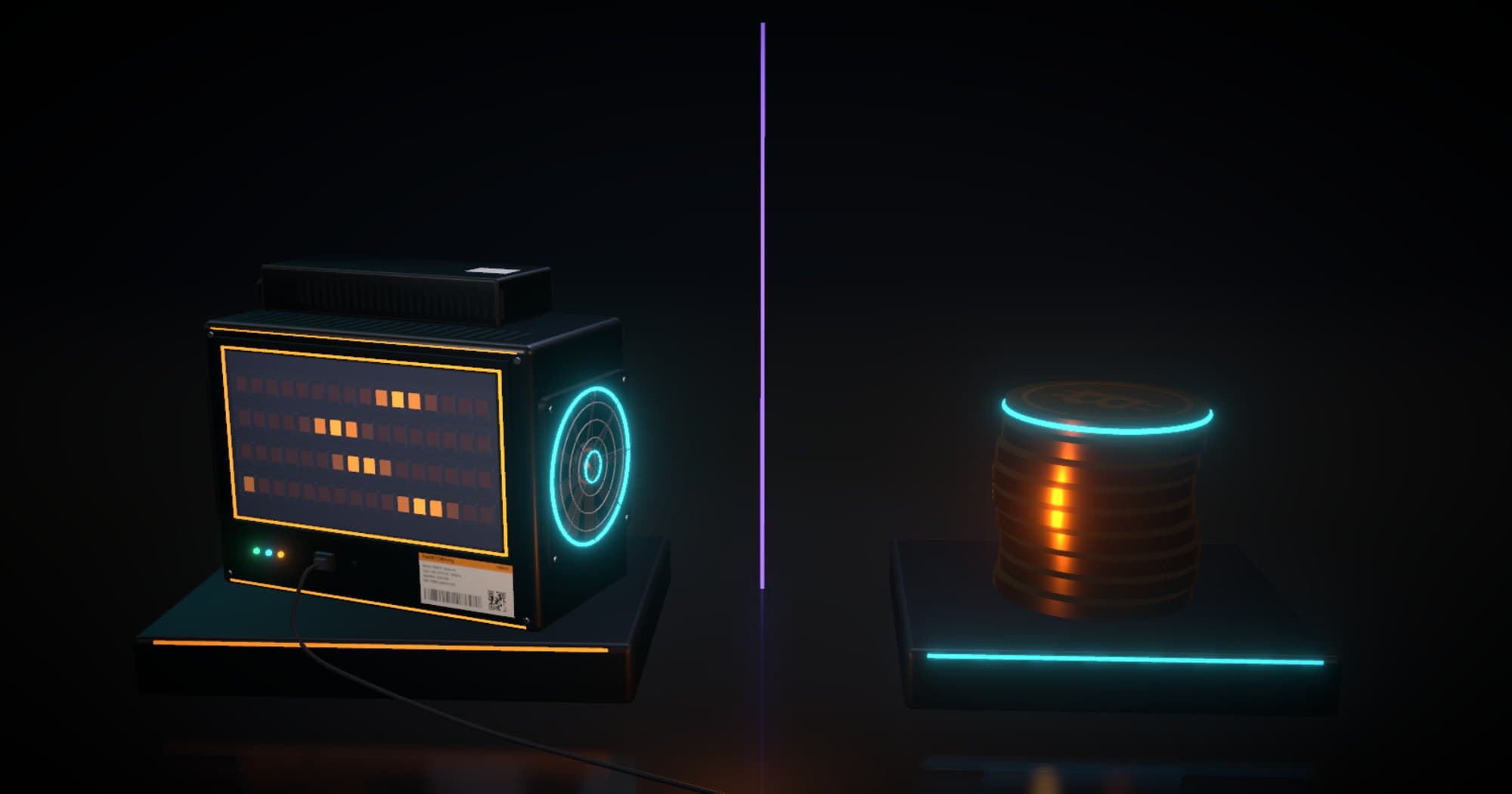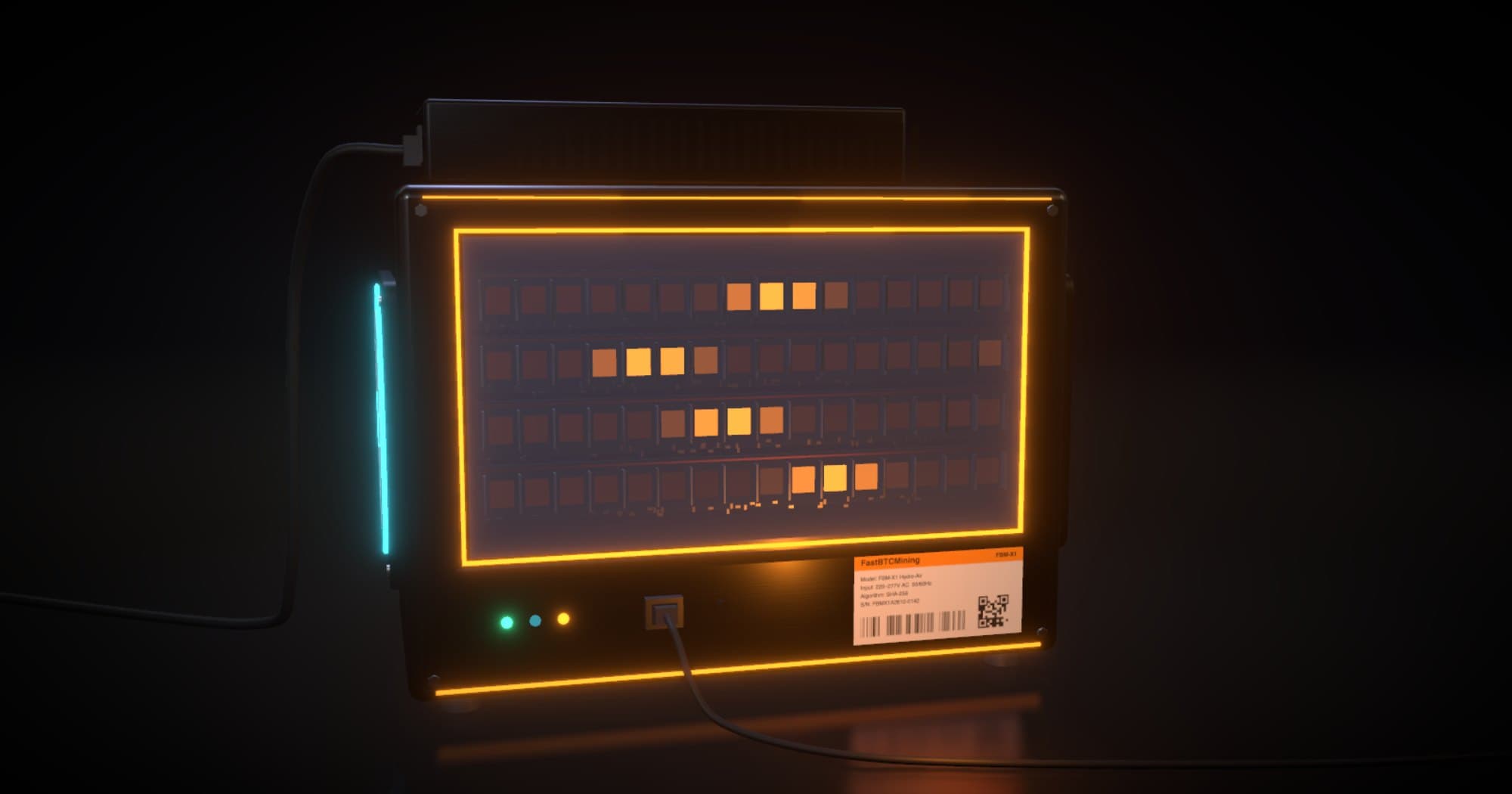
An ASIC miner looks like a metal shoebox with a fan at each end. Inside, it does exactly one thing, computing Bitcoin's SHA-256 puzzle, trillions of times per second, all day, every day. Here is a tour of what is inside the box, how mining hardware got here, and why a single number, joules per terahash, rules the whole industry.
Key takeaways
- ASIC stands for application-specific integrated circuit: a chip designed for a single task, here SHA-256 hashing.
- A typical miner contains a few hash boards covered in chips, a control board, a power supply and powerful fans.
- Efficiency, measured in joules per terahash (J/TH), matters more than raw speed, because electricity is a miner's biggest cost.
- Mining hardware has improved roughly tenfold in efficiency over the last decade, which is why older machines become obsolete.
From laptops to ASICs: a short history
Mining hardware went through four generations in its first five years:
- CPUs (2009). The first miners used ordinary computer processors. A laptop could find blocks.
- GPUs (2010). Graphics cards, designed to run thousands of small calculations in parallel, turned out to be dozens of times faster.
- FPGAs (2011). Reprogrammable chips offered better efficiency, but were short-lived.
- ASICs (2013). The first chips built only for SHA-256 hashing arrived, and everything else became irrelevant almost overnight.
Since then, every generation of Bitcoin miner has been an ASIC. The race is no longer about the type of chip, but about how efficient each new chip is.
What is inside the box
Hash boards
The heart of the machine. A miner usually has three hash boards, each carrying dozens to more than a hundred ASIC chips. Every chip contains many small hashing cores running in parallel. Together, they deliver the machine's total hashrate.
Control board
A small computer that connects the machine to the internet and to its mining pool, hands out work to the hash boards, monitors temperatures and fan speeds, and serves the web interface operators use to configure it.
Power supply
A flagship machine draws around 3,500 W, more than a typical household oven. The power supply converts the incoming AC power to the low-voltage DC the chips need, and its own efficiency matters, since every lost watt becomes heat.
Fans and cooling
All the electricity a miner consumes ends up as heat. Air-cooled machines push that heat out with high-speed fans, which is where the infamous 75 dB of noise comes from. Hydro-cooled and immersion-cooled models remove heat with liquid instead, which allows higher performance and quieter operation, but requires dedicated infrastructure.
- Antminer S9, the reference miner of 2016
- ~98 J/TH
- Antminer S9, the reference miner of 2016
- Antminer S21, released in 2023
- ~17.5 J/TH
- Antminer S21, released in 2023
- Antminer S23, today's air-cooled flagship
- ~11 J/TH
- Antminer S23, today's air-cooled flagship
Why efficiency beats raw speed
Imagine two machines with the same hashrate. One needs 3,500 W, the other 5,000 W. They earn exactly the same rewards, but the second one spends over 40% more on electricity. Over months, that difference decides whether a machine is worth running at all.
That is why the industry rates miners in joules per terahash: the energy needed to compute one trillion hashes. Divide a machine's power draw in watts by its hashrate in TH/s and you get its J/TH. For an Antminer S23, 3,498 W ÷ 318 TH/s ≈ 11 J/TH.
Efficiency also decides which machines survive a halving. When the block subsidy is cut in half overnight, the least efficient machines are the first to be switched off.
The life cycle of a miner
A new ASIC usually starts its career in a large facility with cheap power. As newer, more efficient models arrive and network difficulty climbs, its margin shrinks. Some machines are then resold to operators with even cheaper electricity, others are retired.
In practice, a miner's useful life is often a few years, sometimes longer when power is very cheap. That depreciation is one of the main costs of owning hardware, and one of the reasons people compare buying a machine with renting hashrate, as we do in Cloud Mining vs. Running an ASIC at Home.
Can an ASIC do anything else?
No. A Bitcoin ASIC can only compute SHA-256 hashes. It cannot run software, render graphics or mine coins that use a different algorithm. That single-mindedness is exactly what makes it so efficient, and why a retired Bitcoin miner has little use outside of mining.
Frequently asked questions
What does J/TH mean?
Joules per terahash: the amount of energy, in joules, a machine uses to compute one trillion hashes. Lower is better. You can calculate it by dividing a machine's power draw in watts by its hashrate in TH/s.
How long does an ASIC miner last?
Physically, many machines run for five years or more with fan and power supply replacements. Economically, their useful life is often shorter, because newer, more efficient models make them uncompetitive unless electricity is very cheap.
Why are ASIC miners so loud?
Because they turn several kilowatts of electricity into heat in a small box, and air-cooled models need high-speed fans to move that heat out fast enough. Liquid-cooled models are much quieter.
This article is for general information only and is not financial, investment, legal or tax advice. Mining rewards depend on network difficulty, block rewards and the price of Bitcoin, and are not guaranteed.